Table of Contents
History of NVIDIA: How a Denny’s Booth Built an AI Empire
The History of NVIDIA began in 1993 inside a humble California Denny’s booth where three engineers envisioned a future powered by 3D graphics. Jensen Huang, Chris Malachowsky, and Curtis Priem realized that specialized chips could solve complex visual problems that general processors simply could not handle. Despite facing early near-bankruptcy and skepticism from competitors, their relentless focus on the gaming market led to the invention of the GPU in 1999. This single innovation shifted the tech landscape, transforming the company from a struggling startup into the dominant backbone of the global AI revolution. Today, that small-booth dream fuels everything from blockbuster video games to the world’s most advanced autonomous machines.
The NV1 Disaster: Why Their First Chip Almost Killed the Company
The NV1 Disaster nearly ended NVIDIA’s journey before it truly began because the company bet on the wrong technology. In 1995, NVIDIA launched the NV1 chip using “quadrilateral” surfaces, while the rest of the industry moved toward “triangle” rendering for 3D graphics. This massive technical gamble meant the chip could not run the newest Windows games or support the industry-standard DirectX software. Sales plummeted, and the company faced a brutal cash shortage that brought them within weeks of total bankruptcy. Only a desperate pivot and a miracle investment from Sega allowed the team to survive this catastrophic first mistake.
Did a Secret Deal with Sega Save the Future of Graphics?
A secret $7 million deal with Sega became the ultimate lifeline that saved NVIDIA from certain death during the late nineties. Sega hired the struggling startup to build the graphics engine for their next console, but NVIDIA’s technology was already outdated and failing. CEO Jensen Huang took a massive risk by admitting the project would fail and asked Sega’s leadership to pay the contract in full anyway. In a shocking move of corporate mercy, Sega CEO Shoichiro Irimajiri agreed to the payment, providing the vital cash flow NVIDIA needed to stay afloat. This bold honesty allowed NVIDIA to abandon their flawed designs and focus entirely on the RIVA 128, the chip that finally conquered the market.
The RIVA 128 Gamble: 120 Days to Avoid Total Bankruptcy
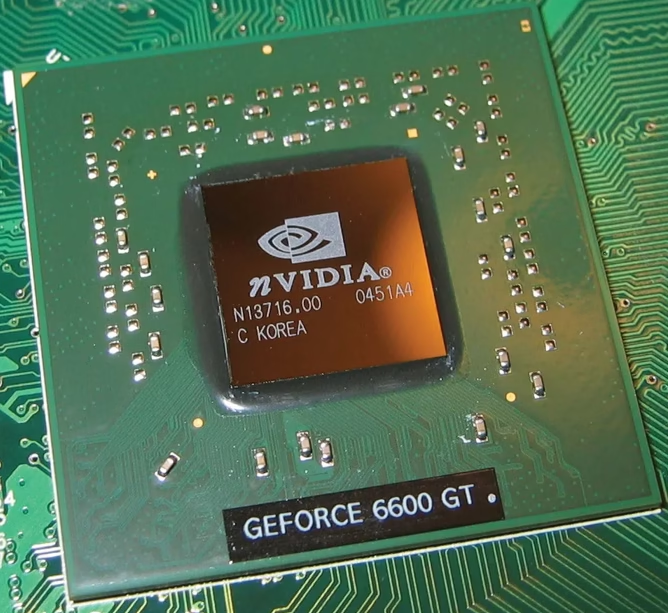
In 1997, NVIDIA faced a make-or-break moment with the RIVA 128, just 30 days from bankruptcy. With nearly empty funds and half its staff laid off, engineers worked nonstop, abandoning failed designs and betting everything on a new 128-bit, triangle-based architecture. The risk paid off: the RIVA 128 sold one million units in four months and beat every competitor, transforming NVIDIA from a struggling startup into a rising hardware powerhouse.
How the Invention of the GPU Changed Gaming Forever
The invention of the Graphics Processing Unit (GPU) in 1999 shifted the heavy lifting of 3D rendering from the CPU to a dedicated, high-speed processor. Before this, computers struggled to handle complex visual calculations, which led to blocky graphics and slow frame rates. NVIDIA’s GeForce 256 was the first chip to combine lighting and transformation engines directly on the hardware, allowing for cinematic detail in real-time. This breakthrough freed the main processor to handle game logic and physics while the GPU created lush, immersive worlds. This shift birthed the modern era of high-definition gaming and set the stage for the hyper-realistic visuals we see in titles today.
The CUDA Revolution: Turning Video Cards into Supercomputers
The History of NVIDIA changed forever when the company unlocked the hidden power of graphics cards for more than just gaming. In 2006, they launched CUDA, a platform that allowed scientists to use GPU cores for massive mathematical calculations. This shift turned standard video cards into affordable supercomputers for weather forecasting and medical research. By creating a language for parallel processing, NVIDIA laid the groundwork for the modern AI boom. This move transformed the company from a gaming brand into an essential engine for global scientific innovation.
Why Did NVIDIA Pivot from Gaming to Artificial Intelligence?
In the History of NVIDIA, the pivot to Artificial Intelligence occurred because CEO Jensen Huang realized that the same math used to render video games was perfect for “training” computers. In 2012, a breakthrough AI called AlexNet used two NVIDIA gaming cards to beat the world’s best software in an image-recognition contest. This moment proved that GPUs could process thousands of calculations simultaneously, making them much faster than traditional computer brains for complex AI tasks. Recognizing a massive new market, NVIDIA immediately shifted its entire engineering focus toward deep learning and data centers. This bold decision transformed the company from a specialized gaming brand into the indispensable powerhouse behind the global AI revolution.
The Mobile Failure: What Happened to the Tegra Phone Chips?
NVIDIA tried to conquer the smartphone world with its Tegra processor, but the project ultimately crashed due to high power consumption and poor connectivity. While the chips offered impressive gaming graphics, they drained phone batteries too quickly and lacked the integrated 5G and LTE modems that competitors like Qualcomm provided. Phone manufacturers eventually turned away, leaving the Tegra line without a home in the mobile market. However, this “failure” found a surprise ending when Nintendo chose the Tegra chip to power the massive hit, the Nintendo Switch. This pivot saved the technology and proved that while the chip failed in pockets, it thrived on consoles.
Crypto Mining Chaos: How Digital Gold Shook the Supply Chain
NVIDIA’s history hit a turbulent peak during the cryptocurrency booms, as miners bought up graphics cards, tripling prices and emptying shelves for gamers. When the crypto bubble burst, NVIDIA faced a major inventory crisis. The company responded by introducing Lite Hash Rate cards to limit mining and separate products for miners, forcing a supply-chain overhaul and proving its chips had become digital-age currency.
The Failed ARM Acquisition: A $40 Billion Regulatory Nightmare
NVIDIA attempted to pull off the largest deal in semiconductor history by offering $40 billion to acquire the British chip designer ARM. This move terrified the tech industry because almost every smartphone and tablet on Earth relies on ARM’s specific architecture. Competitors and world governments feared that NVIDIA would limit access to these vital blueprints, leading to a massive global monopoly. After two years of intense legal battles and investigations by regulators in the US, UK, and China, the deal finally collapsed in 2022. This high-stakes failure remains a pivotal moment in the History of NVIDIA, showing that even the world’s most powerful chipmaker cannot always bypass international competition laws.
Jen-Hsun Huang’s Leather Jacket: The Symbol of a Tech Icon
Jensen Huang wears a black leather jacket at every major product launch to project a consistent, edgy brand image. This signature look transformed the CEO into a recognizable tech celebrity, much like Steve Jobs and his black turtleneck. Fans and investors now associate the rugged style with the company’s fast-paced, “rockstar” approach to engineering. While it seems like a simple fashion choice, this branding has become an iconic part of the History of NVIDIA.
Can Any Competitor Actually Stop the NVIDIA Monopoly?
To break the current market dominance, rivals are attacking the company’s biggest strength: its software. A massive alliance called the UXL Foundation, led by Google, Intel, and Samsung, is building an open-source platform to let developers run AI code on any hardware. This move aims to destroy the “lock-in” that forces engineers to use NVIDIA’s specific tools. At the same time, cloud giants like Amazon and Meta are designing their own custom processors to avoid high retail prices and supply shortages. While new chips like the AMD Instinct MI450 offer faster performance for specific tasks, these software and custom hardware efforts represent the most serious threat to the NVIDIA.
How DLSS Fixed Gaming Performance Gaps
NVIDIA solved the problem of low frame rates by using AI to upscale images in real-time. This technology, called Deep Learning Super Sampling (DLSS), allows a game to render at a lower resolution while displaying a crisp, high-definition output. By using dedicated AI Tensor Cores, the GPU can predict and fill in missing pixels to boost performance without sacrificing visual quality. This breakthrough effectively extended the lifespan of older hardware and became a defining chapter in the History of NVIDIA.
From Pixels to Proteins: How Ray Tracing Transformed Scienc
Ray tracing has evolved from a simple tool for realistic video game lighting into a revolutionary engine for medical discovery. Scientists now use these light-simulating algorithms to model the complex structures of proteins and human cells with extreme accuracy. By calculating how billions of light rays interact with molecular surfaces, researchers can visualize exactly how new drugs bind to viruses at a microscopic level. This high-speed visual data allows doctors to simulate surgical procedures in virtual environments before operating on a real patient. These realistic simulations reduce experimental errors and speed up the development of life-saving treatments.
The H100 Explosion: Why Data Centers are Buying Every Chi
The H100 Explosion is driven by the global race to build larger and more powerful artificial intelligence models like GPT-4 and Llama 3. Data centers are buying every available chip because the H100 features a unique “Transformer Engine” that speeds up AI training by nine times compared to previous versions. Its massive memory bandwidth allows companies to process trillions of data points simultaneously, which is essential for creating the chatbots and automation tools used today. Because these chips cut training times from months to just days, they have become the most valuable resource for tech giants and startups alike. This unprecedented demand has turned the H100 into a digital currency, defining the current.
Is NVIDIA Now a Software Company Trapped in a Hardware Body?
NVIDIA has effectively become a software platform company that uses high-performance silicon as its exclusive delivery system. While the world sees them as a chipmaker, CEO Jensen Huang has often stated that they are a software company because their true “product” is the CUDA ecosystem. This software layer acts as a gatekeeper, as it contains decades of optimized code and tools that competitors like AMD cannot easily replicate. Most developers stay with NVIDIA not for the raw chip speed, but because their existing software only runs flawlessly on NVIDIA’s proprietary platform. This deep integration means that buying their hardware is actually a purchase of the software license required to lead in modern AI.
The Omniverse Vision: Building the Foundation of the Industrial Metaverse
The Omniverse Vision is transforming global manufacturing by creating physically accurate digital twins that allow companies to test entire factories in a virtual world. Using a universal 3D language called OpenUSD, industrial giants like BMW, Siemens, and PepsiCo can sync their digital models with real-time sensor data from the physical floor. This “industrial metaverse” lets engineers identify up to 90% of potential production issues before a single machine even moves. By simulating robot coordination and logistics in a risk-free environment, businesses are slashing planning times and reducing resource waste by over 30%. This shift effectively turns the History of NVIDIA from a story about gaming pixels into a blueprint for the future of autonomous, AI-driven industry.
How Deep Learning Super Sampling (DLSS) Fixed Performance Gaps
Deep Learning Super Sampling (DLSS) improves performance by using AI to render games at lower resolutions and upscale them in real time. Instead of calculating every 4K pixel, the GPU renders a smaller frame while AI-powered Tensor Cores reconstruct missing details. Newer DLSS versions even predict future frames using advanced models, dramatically boosting frame rates. This breakthrough lets older or mid-range GPUs run modern games smoothly and has become a crucial milestone in NVIDIA’s history.
The Next Decade: Will AI Chips Outpace Human Intelligence?
In the coming decade, AI chips will evolve from processing data to human-level reasoning across science and industry. NVIDIA’s Rubin architecture, launching in 2026, marks a major shift with up to a 900× performance leap, enabling “agentic AI” systems that can plan and execute complex tasks independently. As chips become powerful enough to help design their own successors, the divide between machine and human intelligence may vanish in specialized fields, pointing to AGI as the next defining chapter in the History of NVIDIA —possibly before 2030.
Legacy of Innovation: What is the Real Secret to Their Survival?
The secret to survival lies in a “flat” corporate structure that allows the company to pivot toward new markets with incredible speed. Unlike rigid competitors, the leadership encourages teams to constantly experiment and even replace their own successful products before a rival can. This culture of “constructive paranoia” ensures that the company never becomes comfortable or slow, even while dominating the market. By treating every major tech shift—from gaming to crypto to AI—as a life-or-death challenge, they maintain the agility of a startup. This relentless focus on long-term bets over short-term profits remains the core pillar.
About the Author